
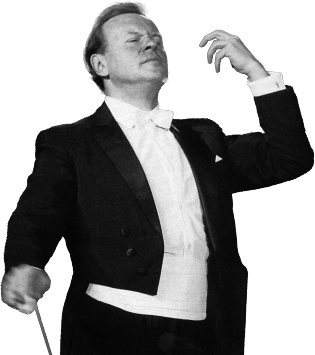


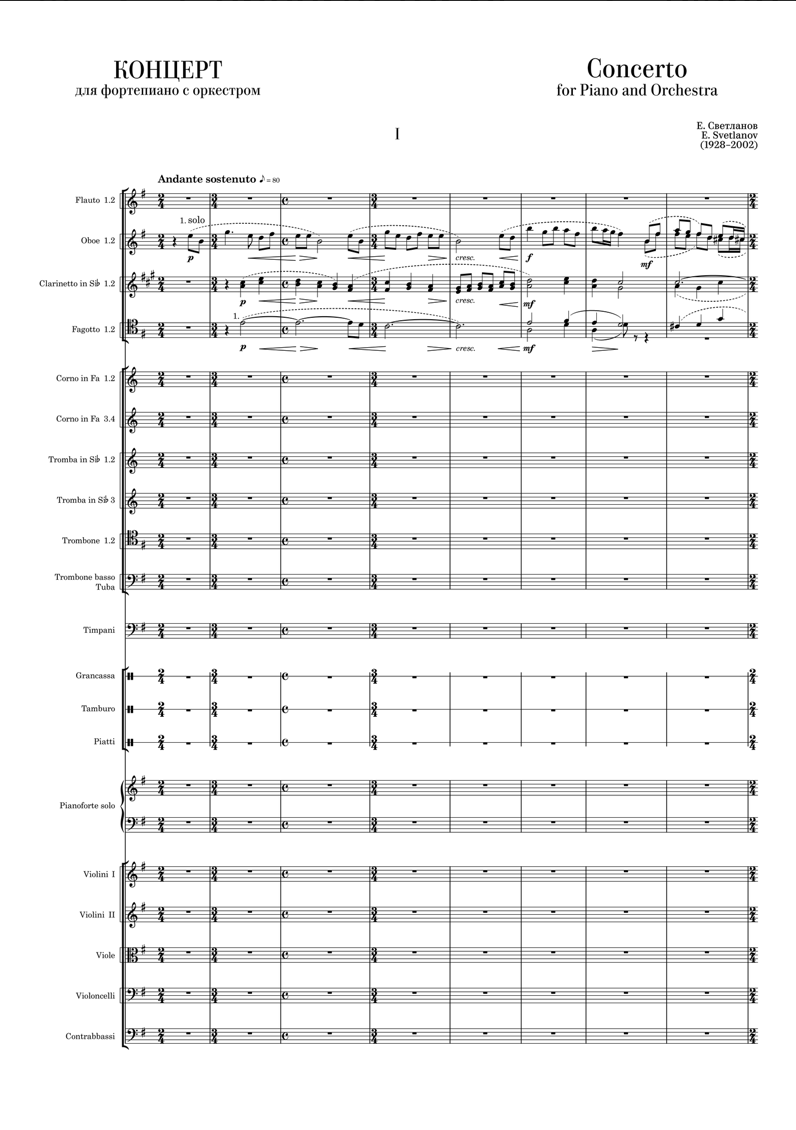
Evgeny Svetlanov began composing his Piano Concerto in 1961, initially conceiving it as a large-scale work in three movements. After a long process of revision, the concerto ultimately took shape in a two-movement version, which the composer himself premiered fifteen years later as soloist — a testament to his exceptional stature not only as a conductor and composer, but also as an accomplished pianist.
The Piano Concerto stands among Svetlanov’s most significant symphonic works, alongside his Symphony and Spanish Rhapsody. Deeply rooted in the Russian musical tradition, it combines expressive lyricism with a commanding orchestral architecture, marked by melodic richness and dramatic clarity.
The two movements form a coherent and complete musical whole. The first movement, in E major, unfolds as an independent lyrical world, characterized by expansive themes and a reflective, nostalgic atmosphere. The second movement, centered in C minor, assumes the dramatic and tonal core of the concerto, bringing together the work’s most decisive musical events and culminating in a powerful dialogue between solo piano and orchestra.
By reaffirming intuition, melody, and emotional depth within a genre already heavily explored, Svetlanov’s Piano Concerto occupies a distinctive place in twentieth-century repertoire. It stands as one of the major Russian piano concertos conceived within a tradition that privileges expressive immediacy and symphonic breadth over experimental abstraction.
Movements:
- Andante sostenuto
- Allegro non troppo