
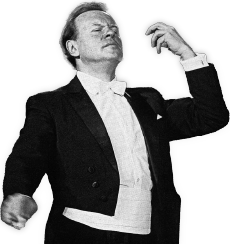


Art rewards those who devote themselves to it wholly and unreservedly. That is the happiness of our profession. That is the meaning of a musician’s life.
Evgeny Svetlanov
Evgeny Fyodorovich Svetlanov was born in Moscow on September 6, 1928, into a musical family of Bolshoi Theatre artists. From early childhood, he responded to the call of the stage, performing alongside his mother in the role of Cio-Cio-San’s son.
“It may sound strange, but for as long as I can remember, I knew I would become a conductor.”
Svetlanov studied at the Gnessin School of Music under Maria Alexandrovna Gurvich, a student of Nikolai Medtner. She nurtured in him a love for Medtner’s music, which he carried throughout his life. Evgeny Svetlanov began studying composition with none other than Mikhail Fabianovich Gnesin himself.
At the Moscow Conservatory, he entered two departments: opera conducting under Alexander Gauk and composition under Yuri Shaporin. His piano professor was the great Heinrich Neuhaus.
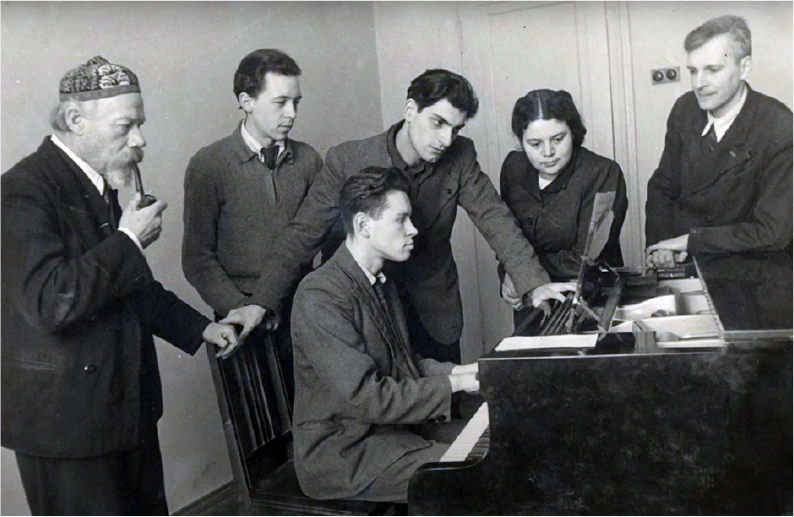
Mikhail Gnessin (on the left) and his students.
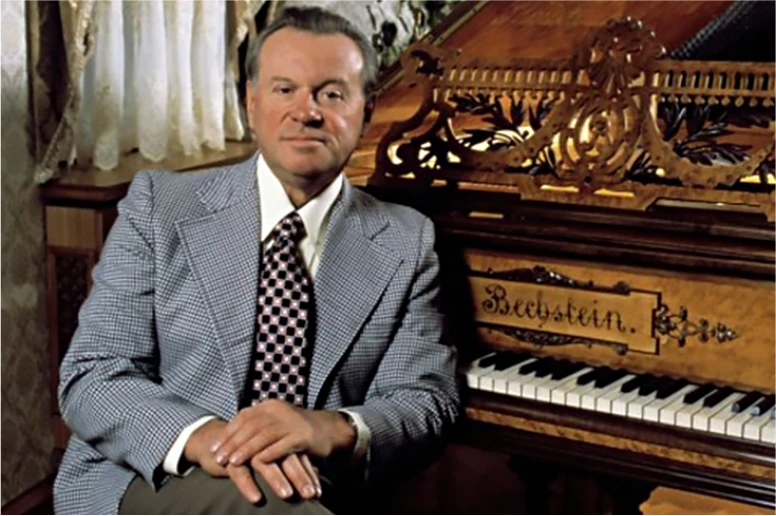
Evgeny Svetlanov at the piano.
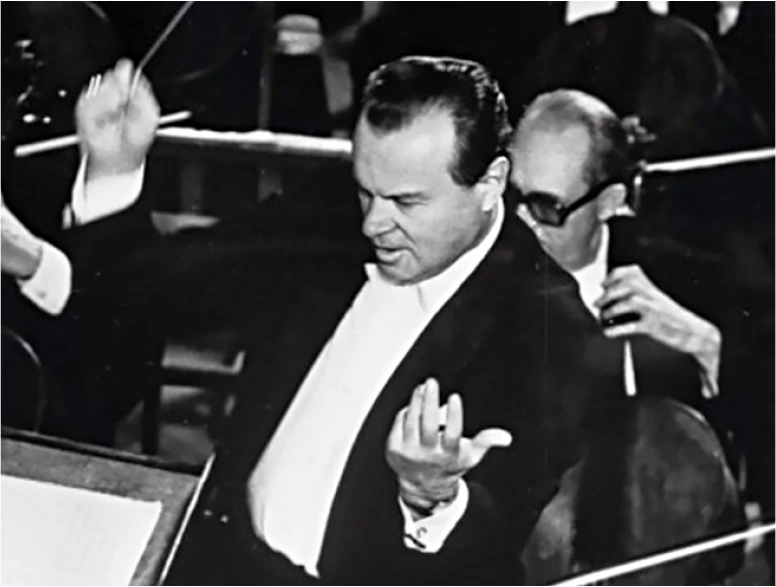
The Beginning of the Artistic Path
“– What led you to take up conducting? – A firm desire to bring unjustly forgotten works—especially of Russian classical music—back to life.”
In 1953, Alexander Gauk, founder of the State Symphony Orchestra of the USSR, invited Svetlanov to participate in his concert program. On March 5, 1953, Svetlanov presented one of his own compositions—the symphonic poem Daugava—for the first time to the public.
Two months later, he conducted the same work with the Leningrad Philharmonic’s Grand Symphony Orchestra. Thus began both his conducting and composing careers.
The Bolshoi Theatre
“There is no world outside music for me.”
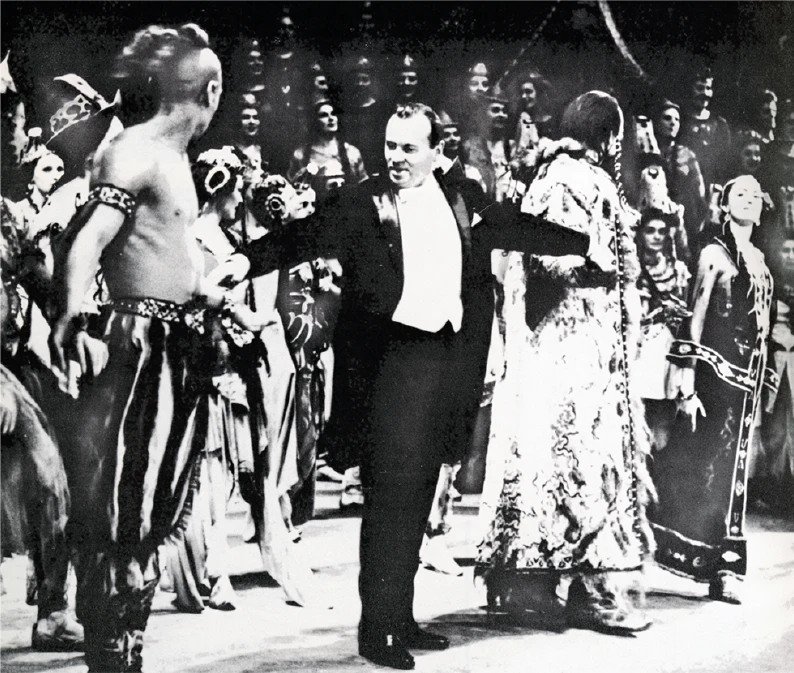
In 1955, shortly after graduating, Svetlanov began conducting at the Bolshoi Theatre as assistant conductor with Rimsky-Korsakov’s The Maid of Pskov. He would remain at the Bolshoi for ten years and serve as its chief conductor from 1962 to 1964. He led 25 productions there, 12 of which he staged himself.
Under Svetlanov, the Bolshoi presented Faust by Gounod, Rigoletto and Otello by Verdi, and several ballets including Night City based on Bartók’s The Miraculous Mandarin. At that time, the conductor’s artistic interests were also focused on Russian music. He conducted Boris Godunov, The Tsar’s Bride, The Enchantress, Not Only Love by Shchedrin, and a concert version of the opera-ballet Mlada. He also recorded The Queen of Spades and Khovanshchina for film-opera adaptations.
The USSR State Academic Symphony Orchestra
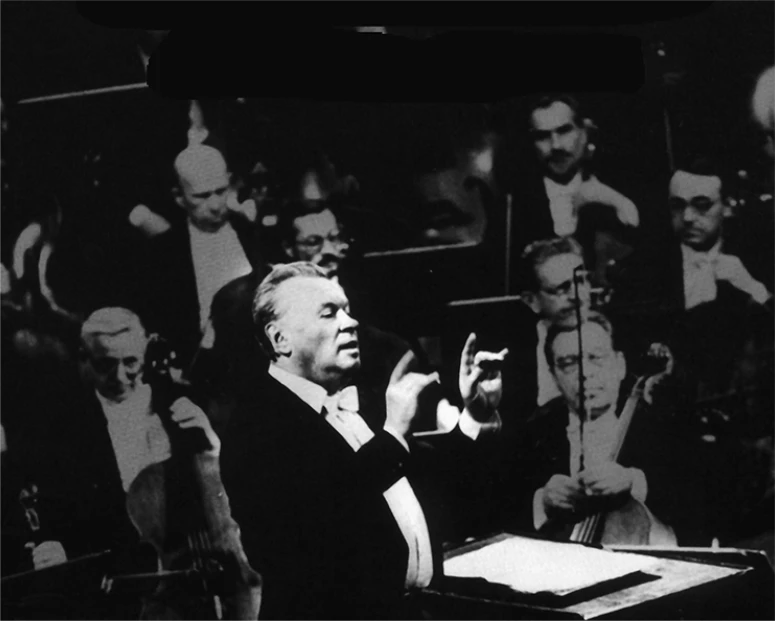
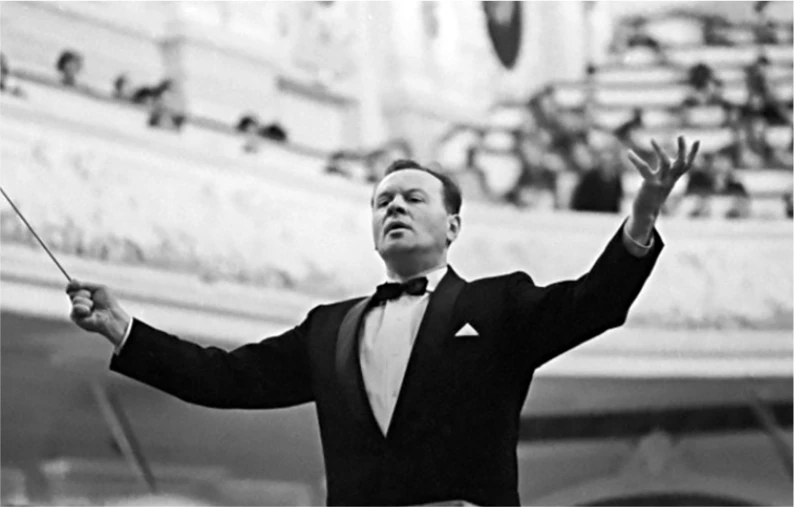
In 1965, immediately after a triumphant Bolshoi tour in Italy, Svetlanov was appointed chief conductor of the USSR State Academic Symphony Orchestra. With this orchestra, the Maestro would embark on a vibrant creative journey, bringing all his musical ideas to life. The richness of the Russian style and music would be revealed in all its power and expressiveness — to audiences both in his homeland and abroad. Over 35 years of leadership, he also introduced Soviet audiences to a vast repertoire of foreign composers, conducting works by Beethoven, Brahms, and Schubert, as well as Elgar, Villa-Lobos, Bloch—and, for the first time in the USSR, Mahler’s complete symphonies.
“I never wasted time and lived by the principle: ‘Only forward.’ So much great music has been written that several lifetimes wouldn’t be enough to perform it all.
Programs of Evgeny Svetlanov with the USSR State Academic Symphony Orchestra:
Anthology of Russian Symphonic Music
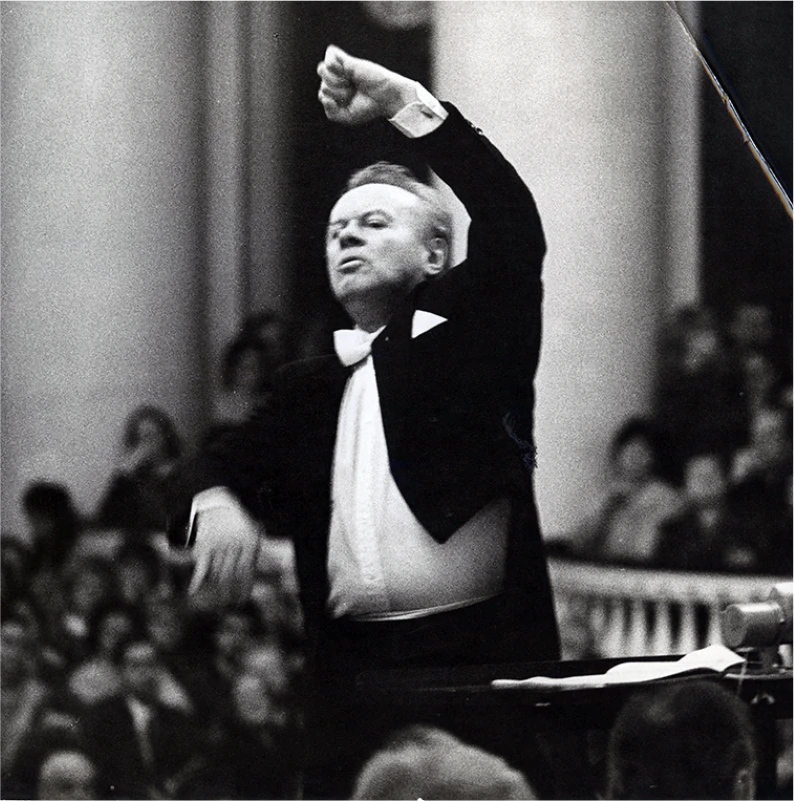
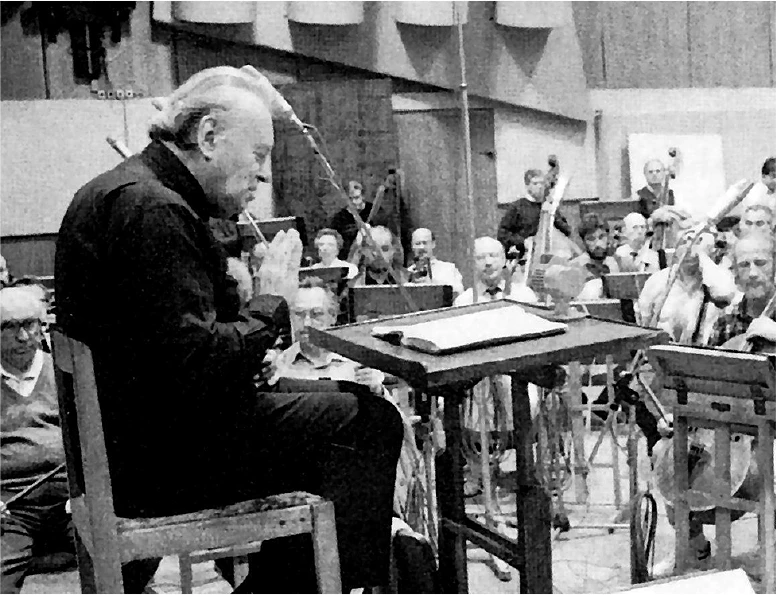
Svetlanov considered his greatest accomplishment the creation of the legendary Anthology of Russian Symphonic Music, which included all the symphonies of Tchaikovsky, Rachmaninov, and Myaskovsky, along with numerous works by Arensky, Balakirev, Borodin, Kalinnikov, Medtner, Rimsky-Korsakov, Lyadov, Glazunov, Scriabin, Stravinsky, Sviridov, and more.
“In the end, one must define why they live. Every person is born for a reason and must fulfill their mission. No one else can do it for them. I defined mine through creating the anthology of Russian music and through recording.”
Svetlanov worked on the anthology for over 25 years. From a young age, he was driven by the idea of reviving forgotten pages of Russian music. His vision—to present a full picture of Russian musical art spanning 150 years from Glinka to Rachmaninov—was brilliantly realized. In 2017, the Melodiya label released Evgeny Svetlanov’s Anthology of Russian Symphonic Music on 120 CDs.
International Recognition
In the 1990s, as Russia opened to the world, Svetlanov’s orchestra was renamed the State Academic Symphony Orchestra of Russia. Svetlanov was invited to lead major foreign orchestras. From 1992 to 2000, he was chief conductor of The Het Residentie Orkest in Netherlands, and from 1997 to 1999, of the Swedish Radio Symphony Orchestra.
He introduced many unknown works to Russian and international audiences. His foreign repertoire was strikingly diverse: German (from Bach to Schoenberg, especially Mahler), French (Debussy, Ravel, Dukas), English, Scandinavian, and Czech. Svetlanov proudly referred to himself as a “man of the universe.”
Over a decade of international activity, he conducted an astonishing number of leading orchestras:
- BBC Symphony Orchestra, Philharmonia, London Symphony, London Philharmonic (UK)
- Philadelphia Orchestra (USA)
- Orchestre de Paris, Orchestre National de France, Radio France Philharmonic Orchestras, Strasbourg and Montpellier Philharmonics (France)
- Orchestra di Santa Cecilia (Italy)
- NHK Symphony Orchestra (Japan)
- Berlin and Munich Philharmonics (Germany)
- Vienna Symphony Orchestra (Austria)
- Théâtre Royal de la Monnaie Orchestra (Belgium)
- Royal Concertgebouw Orchestra (Netherlands)
- Swedish Radio Symphony Orchestra
- Finnish Radio and Philharmonic Orchestras
- Danish Radio Symphony Orchestra
- Oslo Philharmonic, Gothenburg Symphony Orchestra, and many more
Dismissal from the Russian State Symphony Orchestra
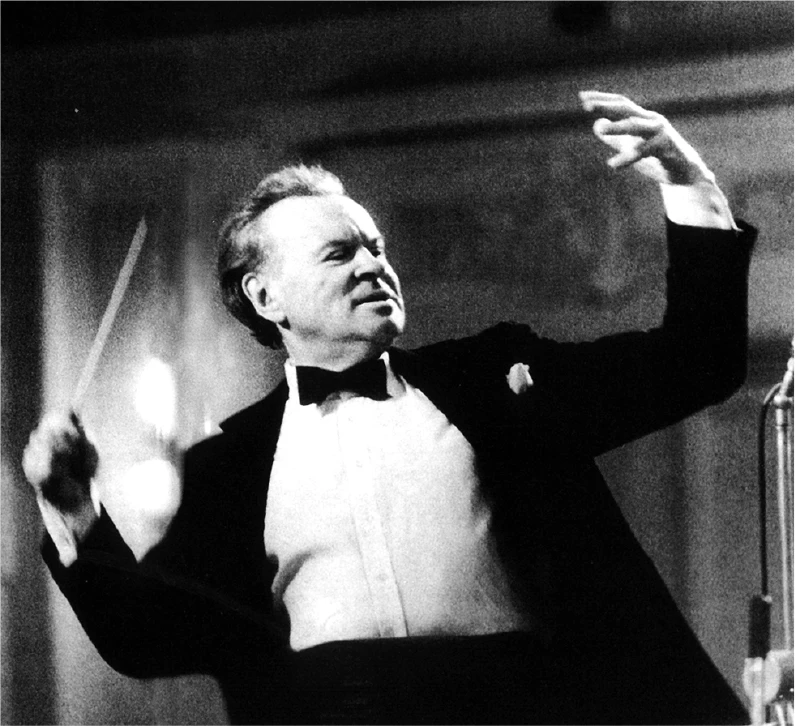
On April 16, 2000, after years of behind-the-scenes maneuvering, Svetlanov’s contract with the Russian State Symphony Orchestra was terminated—a devastating blow for the maestro, who had worked with the ensemble for 45 years. He later wrote the essay How I was driven out of Russia, in which he not only bid farewell to the orchestra and his country, but also seemed to foresee the developments that would unfold in Russia over the next 25 years.
Compositional Work
“In my life, conducting and composing have equal weight.”
Though sporadic, Svetlanov’s work as a composer was substantial. Despite close ties with Shostakovich, Prokofiev, Khachaturian, and Rodion Shchedrin, his musical style was distinct — conservative by his own admission, deeply rooted in folk motifs and disarming emotional sincerity. He followed the post-Romantic tradition of Rachmaninov and Myaskovsky, the latter being a composer he passionately championed.
His early works include the symphonic poem Daugava, the cantata My Country’s fields, the rhapsody Spanish pictures, a Symphony in B Minor, and several Russian songs. Other works include the symphonic poem The Red Snowball Tree, a Poem for Violin and Orchestra in memory of David Oistrakh, Russian Variations for harp and string orchestra, a piano concerto, as well as choral, chamber, and piano compositions.
His music was highly praised by both critics and audiences. As Rodion Shchedrin wrote:
“Each of his compositions is full of emotional openness and melodic generosity.”
Legacy of Svetlanov
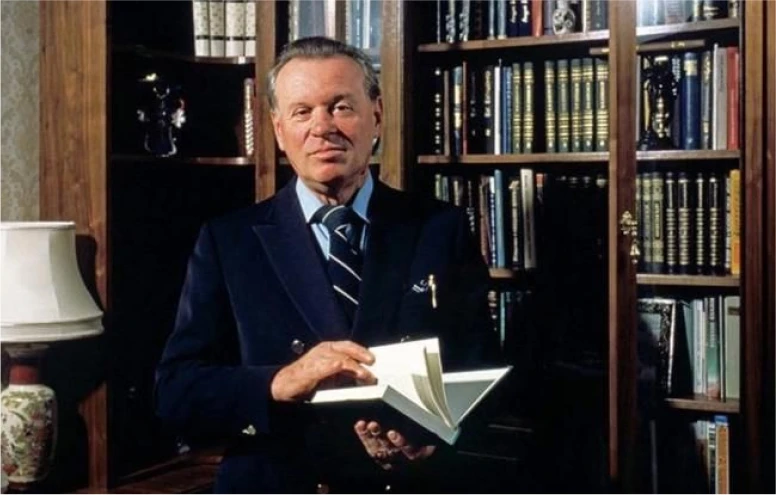
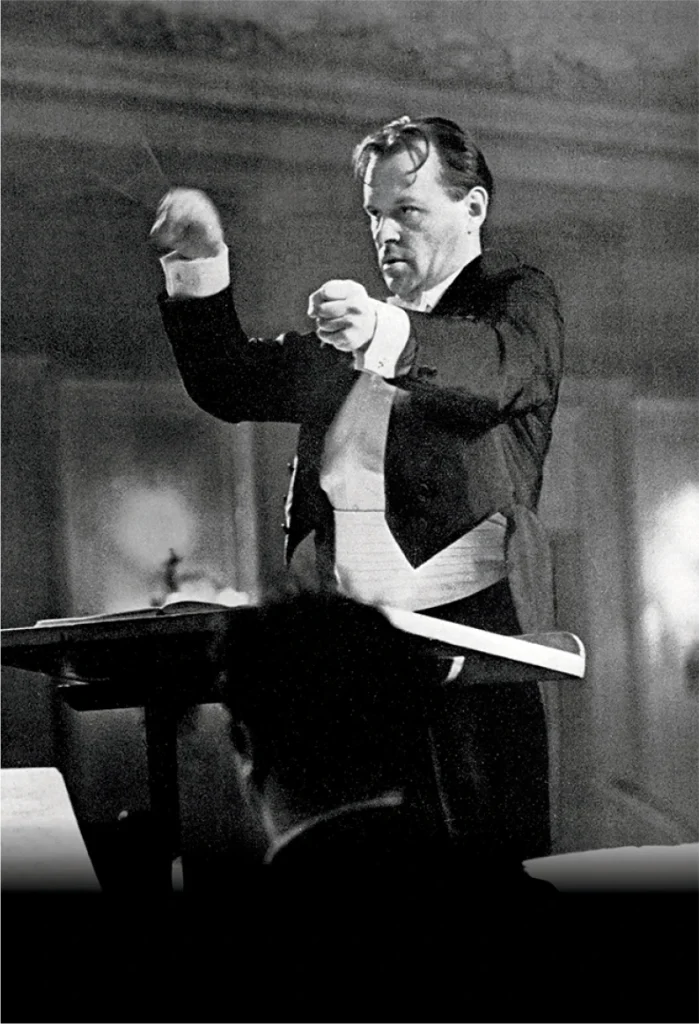
Conductor, composer, pianist, publicist—Svetlanov left an indelible mark on the musical scene of the second half of the 20th century.
“By the scope of his artistic vision, he is the black soil of Russian music. In fact, he left us the finest recordings — a deep bow to him. In the 21st century, he will remain an Atlas of Russian music.” — said Evgeny Kolobov, conductor and founder of the Moscow Novaya Opera Theatre, about Evgeny Svetlanov.
He was honored with numerous awards, including the Order “For Merit to the Fatherland” (2nd and 3rd class), the Order of the Commander (Netherlands), and the Legion of Honour (France).
Evgeny Svetlanov died at home in Moscow on May 3, 2002, at the age of 73. He was buried next to his mother at the Vagankovo Cemetery, as he had wished.
In 2006, the State Academic Symphony Orchestra of Russia was named after Svetlanov. A Grand concert hall in the Moscow International House of Music and a street in Moscow also bear his name. On June 21, 1991, a minor planet—No. 4135—was named “Svetlanov.”
Svetlanov left behind a monumental legacy: around 2,000 video and audio recordings, 175 original compositions, the books Music Today (1985), and Turning the Pages of Life (2014, posthumously), along with numerous interviews, documentaries, TV appearances, letters, and essays.
“If a simple man from a remote village comes to my concert—someone who had never heard anything but an accordion—and leaves wanting to come back again, then my life was not lived in vain.”
In his will, Evgeny Svetlanov expressed his wish to create an international conducting competition to support young talents in their careers. Thanks to his wife, Nina Svetlanova, and his agent Marina Bower, this wish came true in 2007.
FOUND OUT MORE ABOUT THE SVETLANOV COMPETITION
The Maestro bequeathed his intellectual legacy to Mrs. Marina Bower. In 2021, The Svetlanov Legacy Charity was established in London.
FOUND OUT MORE ABOUT THE SVETLANOV LEGACY CHARITY