
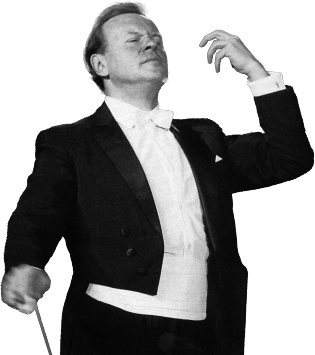


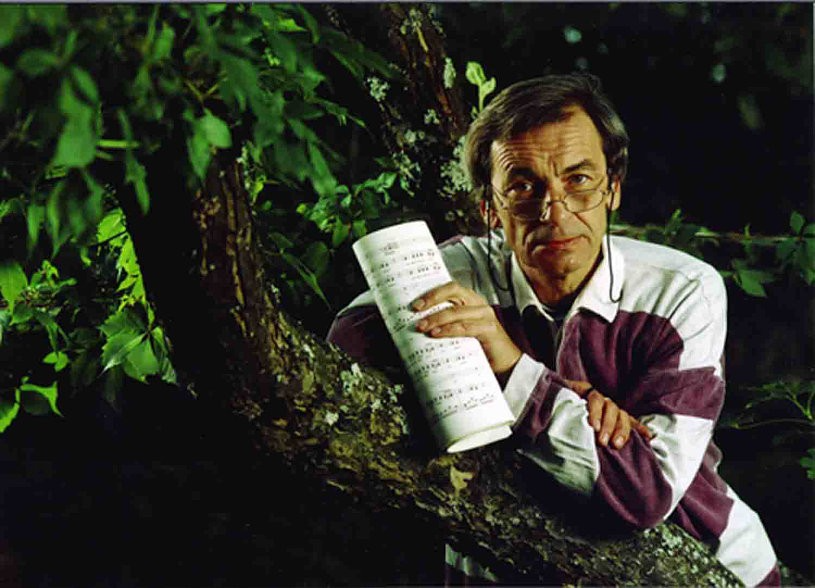
Interview with Evgeny Kolobov by Andrei Maximo
Evgeny Kolobov, Conductor, Founder and Music Director of the Moscow Novaya Opera Theatre
Broadcast: December 26, 2000, “Nochnoy Polet,” Rossiya TV Channel
Maximov: “Nochnoy Polet” is dedicated to the memory of Evgeny Svetlanov. Our guest today is the artistic director of the Novaya Opera Theatre, the remarkable conductor Evgeny Vladimirovich Kolobov.
Kolobov: I was shocked by the news of Evgeny Fedorovich Svetlanov’s passing. It is difficult even to speak about him. I feel that words are insufficient to describe a man of such stature, a conductor and artist of extraordinary caliber. On September 15, he asked me to replace him during his illness. I opened the season with Y. Temirkanov’s orchestra at the Great Hall of the Philharmonic in Leningrad. His name alone inspires awe.
Maximov: An outstanding master has passed. How would you describe Evgeny Svetlanov’s contribution to the world of music?
Kolobov: Evgeny Svetlanov’s work is comparable in scope to Nikolai Mikhailovich Karamzin’s History of the Russian State.
In terms of vision, he is the very heart of Russian music. He left us the finest works, and I bow deeply to him. In the 21st century, he remains an atlas of Russian music.
Maximov: Evgeny Svetlanov once said that the purpose of music is to bring joy to people. Do you agree?
Kolobov: Perhaps not joy, but rather a sense of purification, a catharsis. When you engage with a great work of art, there is a cleansing of the heart, a feeling of life and light.
Maximov: When controversies surrounded Svetlanov and his orchestra, why did so few cultural figures defend his role in Russian music?
Kolobov: In such a tragic departure, one can take solace in Ibsen’s words: “He who has seen God dies.” What happened to him reflects some of the darker traditions of our state. Yet Svetlanov was a man who did not need support. I did not know him personally, but I was stunned by his talent.
Maximov: As a conductor of a younger generation, did you learn from him?
Kolobov: I attended many of his concerts. I was particularly struck when he conducted Rachmaninoff’s Second Symphony for the Lenin Prize, despite being seriously ill. His performance was beyond words—he was creating art in its purest form. Of all his interpretations, his Rachmaninoff remains the benchmark, comparable to Michelangelo’s frescoes. Listening to him makes me question my own work. His mission in music was unique.
Maximov: How can one tell the difference between a great conductor and a lesser one?
Kolobov: You feel it in your heart. When a performance moves you, transports you, that is art. There is a mystery that cannot be fully explained. Svetlanov carried the secret of music—perhaps he understood it himself, but we never will.
For him, music was total; conducting was not merely waving arms, playing notes was not enough. He heard music through the voices of Rachmaninoff and Tchaikovsky, and he worked tirelessly, dedicating his life entirely to it.
Maximov: Many people today say that classical music is being pushed aside by popular genres. Do you think that is true?
Kolobov: Money and ease often take precedence, but music exists across all genres. Art and the market are fundamentally incompatible. I hope classical music will not disappear. The mission of artists is to keep its spirit alive. At our theatre, young audiences fill the halls. Great art must speak to everyone.
Maximov: What should each person leave behind?
Kolobov: A kind mark: raise children, plant a tree, build a house, do good, bring light. When Evgeny Svetlanov passed away, Russia lost a huge part of itself. I dream of Moscow honoring him with a large, bright, tree-lined avenue named Evgeny Svetlanov Avenue.
Maximov: How should we ensure his legacy endures?
Kolobov: A person lives as long as they are remembered. As long as their work survives, they survive. Evgeny Svetlanov will continue to live through his music.
Maximov: And finally, are you afraid of death?
Kolobov: Sometimes, yes. Work can be tragic when you cannot achieve what you envision. But life must be lived fully, so that death feels unjust. Svetlanov lived in such a way that his passing was truly an injustice.
Maximov: Thank you for your reflections. Our broadcast today was dedicated to the memory of Evgeny Fedorovich Svetlanov, and our guest was Evgeny Kolobov.